The glute bridge is a floor exercise. You lie on your back with your knees bent and lift your hips by squeezing your glutes. It strengthens the glutes and hamstrings, takes pressure off a tired lower back, and needs no equipment. It’s one of the best first exercises for anyone who sits a lot, wants a stronger butt, or is getting back into training.
This guide covers step-by-step form, the mistakes that shift the work into your back, six variations, and how the bridge compares with the hip thrust.
How to do a glute bridge
- Lie on your back on a mat, knees bent, feet flat and hip-width apart. Your heels should be about a hand’s length from your glutes.
- Rest your arms by your sides, palms down.
- Brace lightly. Gently pull your ribs down and tuck your pelvis a little so your lower back is neutral, not arched.
- Press through your heels and squeeze your glutes to lift your hips until your body makes a straight line from shoulders to knees.
- Pause for 1 to 2 seconds at the top and squeeze hard.
- Lower slowly over 2 to 3 seconds until your hips just touch the mat.

Start with 3 sets of 12 to 15 reps, resting 45 to 60 seconds between sets.
Breathing: exhale as you lift, inhale as you lower.
What muscles does the glute bridge work?
|
Muscle |
Role |
|
Gluteus maximus |
Main mover; extends the hip |
|
Hamstrings |
Assist hip extension |
|
Gluteus medius |
Keeps the knees from caving in |
|
Deep core muscles |
Keep the pelvis and lower back stable |
|
Lower back (erector spinae) |
Supports, but should not do the main work |
To learn how these muscles work together, see our guide to the glute muscles.
Benefits of the glute bridge
- Stronger glutes for walking, climbing stairs, running, and lifting.
- Less strain on the lower back. Strong glutes take load off the lower back in daily movement.
- Counteracts sitting. Long hours in a chair leave the hip flexors tight and the glutes underused.
- Beginner friendly. No equipment, no balance demands, and low risk.
- Easy to progress with one leg, a band, or added weight.

Common mistakes
- Arching the lower back at the top. If you feel it in your back, you’ve lifted too high. Stop at a straight line and tuck your pelvis slightly.
- Feet too far away. The hamstrings take over and may cramp. Move your heels closer.
- Feet too close. The quads take over. Aim for roughly vertical shins at the top.
- Knees falling in. Push them gently outward, or loop a band above your knees.
- Rushing. Momentum skips the squeeze. Pause at the top of every rep.
6 glute bridge variations (easy to hard)
1. Basic glute bridge
The version described above. Master 3 x 15 with a strong pause before moving on.
2. Banded glute bridge
Loop a mini band just above your knees and press out against it as you lift. This brings in the gluteus medius.
3. Glute bridge march
Lift into a bridge, then slowly raise one foot a few centimetres, set it down, and raise the other. Keep your hips level. This one builds core stability.
4. Single-leg glute bridge
Keep one foot on the floor and either straighten the other leg or hug that knee toward your chest. Lift with the working leg. Do 3 x 8 to 10 per side.
5. Elevated glute bridge
Put your feet on a step, bench, or sofa. The bigger range of motion makes it harder, especially for the hamstrings.
6. Weighted glute bridge
Rest a dumbbell or kettlebell across your hip bones, with a towel underneath for comfort. Start light and build up.

Glute bridge vs hip thrust
The two moves look similar, but the setup changes what you get from them.
|
|
Glute bridge |
Hip thrust |
|
Setup |
Upper back on the floor |
Upper back on a bench |
|
Range of motion |
Smaller |
Larger |
|
Load potential |
Bodyweight to moderate |
Heavy (barbell) |
|
Equipment |
None |
Bench, often a barbell and pad |
|
Level |
Beginner |
Intermediate |
|
Best for |
Learning glute activation, warm-ups, home workouts, rehab |
Building glute size and strength |
Which should you do? Start with glute bridges until you can do 3 x 15 single-leg reps with good form. Then add hip thrusts if you want bigger, stronger glutes and have a bench. Many programs keep both, with bridges in the warm-up and hip thrusts as the main lift.
How to do a hip thrust
- Sit on the floor with the bottom of your shoulder blades against the edge of a bench about knee height.
- Place your feet flat, hip-width apart. If you use a barbell, roll it over your hips and use a pad.
- Drive through your heels and lift your hips until your torso is parallel to the floor.
- Keep your chin tucked and ribs down. Don’t arch your back.
- Squeeze at the top, then lower under control.

A simple glute workout at home
|
Exercise |
Sets x reps |
|
Glute bridge with a pause |
3 x 15 |
|
Banded glute bridge |
2 x 15 |
|
Single-leg glute bridge |
3 x 10 per side |
|
Glute bridge march |
2 x 10 per side |
|
Bodyweight hip thrust off the sofa |
3 x 12 |
Do this two or three times a week. For a complete routine, add squats for women and the moves in our guide on how to tighten your glutes.
What to wear
Bridges and hip thrusts stretch the fabric across your glutes, so choose:
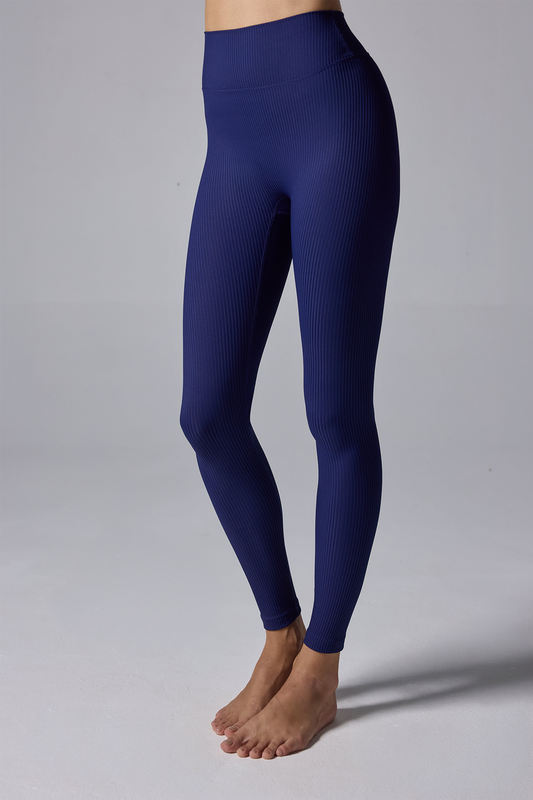
- Squat-proof, high-waist leggings that don’t turn see-through or roll down, like our Evo High Rise Leggings. Here’s how to choose squat-proof leggings.
- A supportive sports bra that’s comfortable when you’re lying on your back.
- A cushioned mat so your shoulders and spine are comfortable. Browse our yoga mats.
FAQ
What does a glute bridge work?
Mainly the gluteus maximus, helped by the hamstrings, gluteus medius, and deep core muscles.
How many glute bridges should I do a day?
For most people, 3 sets of 12 to 15 reps, two to four times a week, is enough. Move to harder variations instead of adding endless reps.
Is the glute bridge or the hip thrust better?
The hip thrust allows more range and heavier loads, so it’s better for building size once you’re strong. The glute bridge is better for beginners, warm-ups, and home training.
Why do I feel glute bridges in my lower back?
You’re probably arching at the top. Lift only to a straight line, tuck your pelvis slightly, and squeeze your glutes before you lift.
Why do my hamstrings cramp during glute bridges?
Your feet are usually too far from your body. Move your heels closer to your glutes.
Can glute bridges help lower back pain?
Stronger glutes can support the lower back, and bridges are often used in rehab. If you have back pain, check with a physical therapist first.
The bottom line
The glute bridge is simple, safe, and effective. Lift with your glutes rather than your back, pause at the top, and work through the single-leg and weighted versions before moving to hip thrusts. Wear high-waist, squat-proof leggings and train on a comfortable mat.
General guidance, not medical advice.