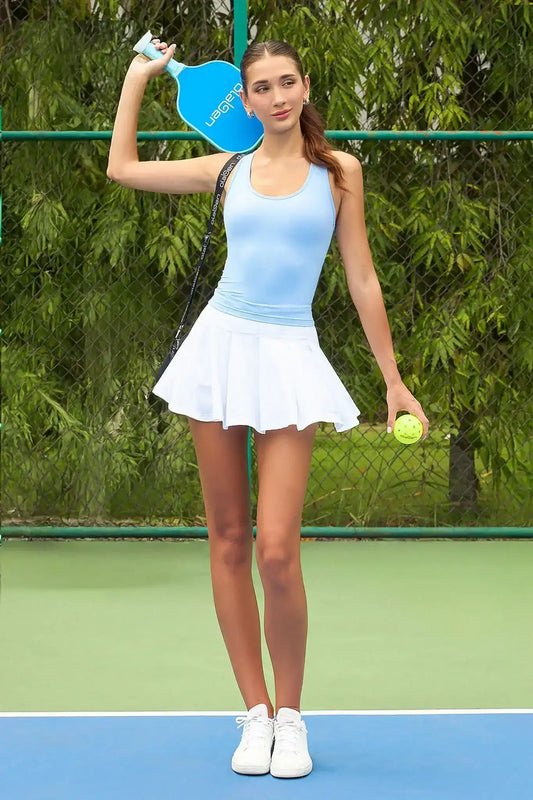
Holding the racket correctly is the foundation that helps every shot become more accurate, powerful, and flexible. This article summarizes the common types of tennis grips, from Continental, Eastern, Semi-Western to Western and Backhand grips, along with an analysis of their advantages and disadvantages, precise execution methods, and important notes. Whether you are a beginner or an experienced player, Olaben will help you understand the mechanics of gripping the racket, improve your practice and match performance, and avoid common mistakes, so that every shot is confident and fluid.
Analysis of the Tennis Racket Handle
The tennis racket handle has an octagonal shape with 8 bevels, numbered from 1 to 8 clockwise when the racket face is perpendicular to the ground. Understanding these bevels is the key to placing your hand accurately, performing the correct grips, and simultaneously complying with the basic principles of tennis rules.
Two important reference points when placing your hand on the racket handle are the index knuckle and the heel pad. The position of these points on the bevels determines the grip you are using. Clear illustrations of the bevels and hand placement can help you visualize and apply them more effectively.
Mastering the structure of the racket handle also allows you to switch flexibly between different grips, from forehand and backhand to serves. When holding the racket, always pay attention to the feel of your hand on the bevels to ensure precision, control, and comfort in every shot.

Common Tennis Racket Grips
Continental Grip (Hammer Grip – Bevel 1)
The Continental Grip is a versatile grip commonly used for serves, volleys, overheads, slices, and defensive shots. This grip is also widely applied when playing at the net, helping players easily control the ball in various situations.
Tennis coaches emphasize that the Continental grip is a basic yet extremely effective grip, especially when performing deep and accurate serves toward the opponent’s court. In addition, it is an ideal choice for developing skills such as volleying or smashing decisively, thanks to the flexible control and adjustment of the racket face.

Advantages:
- Allows the forearm and wrist to naturally pronate through the contact point, making shots smoother, stronger, and less tiring.
- Expands the racket face during preparation, making it suitable for slice shots, low underspin serves, volleys, and backhands.
- A popular grip for Serve, Volley, and Backhand, suitable for a variety of match situations.
Disadvantages:
- Difficult to perform strong topspin shots, meaning the ball may not spin enough or stay safely in the court if hit too hard.
- Easy to hit flat shots (almost straight with little spin), requiring precise angles and positioning to avoid the ball going out.
- Stability is not high when controlling risky shots, demanding precise and sharp technique to minimize errors.
Eastern Forehand Grip (Bevel 2 – Eastern Grip)
The Eastern Forehand Grip is a popular forehand grip that helps generate strong topspin shots while maintaining optimal ball control. This grip is especially suitable for beginners because it feels comfortable and easy to learn. For this reason, many tennis coaches introduce the Eastern Grip as a fundamental foundation for learning forehand strokes.
Advantages:
- Easy to learn and practice, making it an ideal choice for beginners focusing on forehand training.
- Allows brushing up behind the ball to create topspin, or hitting flat shots with power and accuracy when needed.
- Easy to switch to other grips, convenient for moving to the net or changing strategies during a match.
- Suitable for players who want to combine offensive play with control, especially when playing close to the net.
Disadvantages:
- Shots tend to be straighter with less spin, which can make it difficult to maintain consistency during long rallies.
- Not the optimal choice for players who want to apply continuous strong topspin to extend rallies or control the opponent over longer periods.
Semi-Western Grip (Bevel 3 – Semi-Western Grip)
The Semi-Western Grip is a widely used grip favored by many professional players because it allows for powerful shots with a wider margin of error. It is an ideal choice for players who want to combine power, control, and topspin in their forehand strokes.

Advantages:
- Generates stronger topspin than the Eastern Grip, making shots safer and easier to control, especially for lobs or shots into tight angles.
- Expands the racket swing arc, allowing the ball to travel higher and further in front of the body, facilitating aggressive attacks and point control.
- Still allows flat or power shots when needed to finish points.
Disadvantages:
- Quickly switching from forehand to volley can be challenging, as the Semi-Western naturally closes the racket face, requiring an upward swing.
- When moving to the net for volleys, players often need to switch to a Continental grip, which can be inconvenient or feel unnatural if not accustomed.
- Baseline players may find it less flexible when approaching the net using this grip.
Western Grip (Bevel 4 – Western Grip)
The Western Grip positions the heel of the hand on bevel 4, the index knuckle on bevel 5, with a line connecting the heel to the index knuckle lying entirely on bevel 5. This grip is favored by many professional players, especially in Europe and Latin America, due to its ability to generate heavy topspin and maximum control, particularly on clay courts.

Advantages:
- Allows the wrist to press deeply behind the ball, creating powerful topspin and excellent control.
- Ideal choice on clay courts, enabling better ball control, creating unpredictable shots, and forcing the opponent to move frequently.
- Supports strong topspin shots, facilitating aggressive, offensive play and point domination.
Disadvantages:
- Requires more energy due to wrist positioning and the wide swing arc.
- Not suitable for low shots or volleys near the net, as it is difficult to position the racket face comfortably for low shots.
- Requires precise swing technique to avoid losing power or miscontrolling the ball.
Detailed Guide on How to Hold a Tennis Racket
Determine Racket Length and Weight
Racket Length: A standard racket is approximately 27 inches (68.5 cm) long. If you are a beginner, it is recommended to choose a standard racket for easier ball control. Longer rackets can increase your reach, but they are harder to maneuver.
Racket Weight:
- Lightweight racket (260–290g): Suitable for beginners, easy to move, and reduces arm fatigue.
- Heavy racket (300–320g): For players with good technique, provides more hitting power but requires stronger wrists and arms.
Choose Racket Balance
- Head-Heavy: The weight is concentrated at the racket head, helping generate more power, ideal for serves and baseline shots.
- Head-Light: The weight is concentrated at the handle, making the racket easier to control, suitable for volleys and fast shots near the net.
- Even Balance: Suitable for a variety of strokes, a safe choice for beginners.
Select String Tension
- Loose strings (18–22 kg): Ball travels faster and spins easily but is harder to control.
- Tight strings (23–27 kg): Provides better control and accuracy, but requires more strength.
Tip: Beginners should choose moderate tension to balance control and hitting power.
Choose the Right Grip Size
Grip Size: Measure the diameter of the handle so that your hand fits comfortably.
- If the grip is too small → your hand tires easily and is more prone to injury.
- If the grip is too large → harder to rotate the wrist, limiting shot flexibility.
How to measure: Hold the racket and measure the distance from the tip of your little finger to the base of your palm; it should be approximately 1–1.5 cm.
Select Racket Type According to Skill Level and Purpose
- Beginners: Lightweight racket, even balance, large racket head for easier hitting.
- Intermediate Players: Medium-weight racket, flexible, balance according to preference (Head-Light or Head-Heavy).
- Advanced / Professional Players: Heavy, precise racket, supporting topspin and strong shots from the baseline.

How to Choose the Appropriate Tennis Racket Grip
Based on Playing Style
Offensive Style: If you prefer approaching the net and fast, aggressive play, the Continental or Eastern Forehand grips help execute volleys, overheads, and versatile shots effectively.
Defensive Style: Players who prefer baseline play and controlling long rallies benefit from the Semi-Western or Western Forehand grips, which allow better topspin, ball control, and keeping the ball in play.
Serving Style: The Continental grip is a popular choice, offering wrist flexibility and enabling varied power and spin when serving.
Based on Court Type
Hard Court: Eastern or Semi-Western grips are suitable, allowing faster shots and better control.
Clay Court: The Western Forehand grip is ideal, generating heavy topspin, higher bounces, and making it harder for opponents to return the ball.
Grass Court: Continental grip helps hit fast, low shots with flexibility for volleys, suitable for fast courts.
Based on Experience and Hand Strength
Beginners: Should choose Eastern Forehand or Continental grips for easier learning and less hand fatigue.
Intermediate Players: Can try Semi-Western to increase topspin and improve ball control.
Advanced / Professional Players: Can combine different grips depending on the situation, using hand power efficiently, generating topspin, and changing tactics flexibly.
Common Mistakes When Holding a Tennis Racket
Holding Too Tight or Too Loose
Problem: Many players hold the racket too tightly, which strains the wrist and forearm, reduces swing speed, tires the arm quickly, and can even cause injury with prolonged play tennis. Conversely, holding the racket too loosely can make it shake, reduce accuracy and power, and make the ball deviate from the intended direction.
Solution: Hold the racket firmly enough so it won’t slip, but still allow the wrist and arm to move naturally. A helpful visualization is to “hold the racket like you’re holding an egg,” meaning enough force to prevent dropping it without squeezing too hard. Practicing gentle grip and gradually increasing force per stroke helps your hand get accustomed to the right amount of pressure.
Incorrect Hand Placement on the Handle
Problem: Holding the racket at the wrong position is a common mistake, directly affecting the power and accuracy of shots. Holding too high on the handle reduces hitting power and control, while holding too low makes racket control difficult, leading to off-target shots and faster hand fatigue.
Solution: First, identify the correct grip points according to the type of grip you are using, such as Eastern, Western, or Continental. You can use marks on the handle or try different positions to find the most comfortable one for your hand. Once you find the proper position, practice hitting from that point to build a natural habit and improve accuracy.
Not Changing Grip When Necessary
Problem: Many beginners or inexperienced players use a single grip for all shots. This makes transitioning between forehand, backhand, volleys, or smashes difficult, reduces shot efficiency, and makes it easier for opponents to anticipate your moves.
Solution: Learn and practice basic grips such as Eastern, Semi-Western, Western, and Continental. Most importantly, practice switching grips quickly between different strokes. Developing the reflex to change grips based on match situations helps you control the racket better, play more flexibly, and improve tactical effectiveness.
Conclusion
Holding a tennis racket with proper technique is a fundamental foundation that makes every shot more accurate, powerful, and fluid, while also reducing the risk of hand fatigue or injury. Mastering common grips such as Continental, Eastern, Semi-Western, and Western not only improves the effectiveness of practice and match play but also allows players to switch seamlessly between different strokes, from forehand and backhand to volleys and serves. At the same time, paying attention to common mistakes, such as gripping too tightly or too loosely, incorrect hand placement on the handle, or failing to change grips when necessary will help you improve your skills more quickly and confidently on the court.
In addition to proper racket technique, choosing the right tennis apparel plays an important role in providing comfort and supporting effective movement during play. For women’s tennis clothing, tennis clothing options include sports tops, sports shorts, dresses, or skirts that are lightweight, stretchable, and sweat-wicking, ensuring comfort during movement and strokes. For men’s tennis apparel, such as sports shirts and sports shorts designed for a snug yet flexible fit maximizes your ability to swing the racket, run, and change directions quickly.
Combining proper racket grip techniques with appropriate tennis clothing ensures that every tennis session is effective, safe, and enjoyable, enhancing the overall training experience for both men and women.